The Daiwa thermal lance is used for cutting, drilling or demolishing large-sized materials such as iron castings, stainless steels, brass, non-ferrous metals, refractory materials, concrete, ceramics, natural stone, etc.
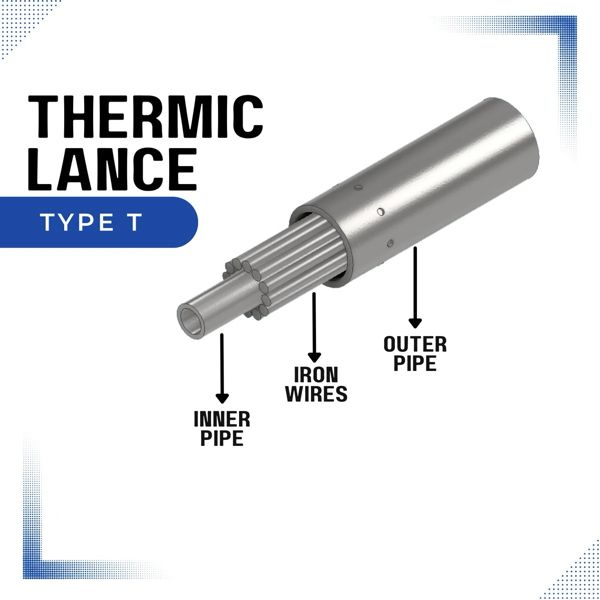
To suit this cutting purpose, its structure has been adapted in two variants: Type T and Type W.
Daiwa thermal lance structure (T-type)
- One outer tube
The outer cylindrical structure of the Daiwa thermal lance is usually made of mild steel. It serves as a protective sheath for the inner core components and contains the necessary reagents for exothermic cutting. The outer tube is usually available in various lengths and diameters to suit different cutting requirements. - A mixture of iron wires
The inner core of the Daiwa thermal lance is where the exothermic cutting occurs. It usually consists of a mixture of metal alloy rods, such as iron. These rods are arranged compactly inside the lance tube and play a central role in generating the extreme heat required for cutting. - One inner tube
The inner tube of the Daiwa Thermic Lance is deliberately positioned in the center of the bore to maintain a balance with the surrounding iron wires. This unique arrangement ensures optimum performance and efficiency during operation, enabling precise and controlled thermal cutting and drilling processes.
Daiwa thermal lance structure (W-type)
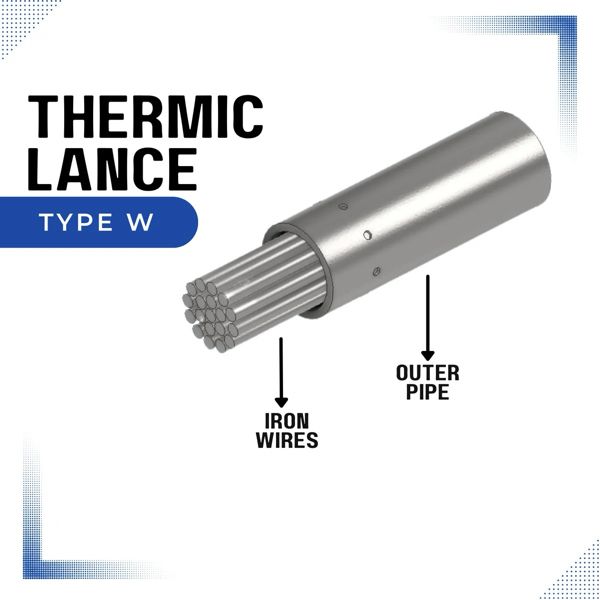
The structure of the Daiwa thermal lance with the W type is quite similar to that of the T type, but it does not have an inner tube in the center of the lance tube.
- One outer tube
Following the pattern of the Type T, the Type W also has a cylindrical structure that surrounds the iron wires inserted inside the Daiwa Thermic Lance. With this protective shield, factory operators can rest easy knowing that the iron wires inside the Daiwa Thermic Lance will remain securely and firmly in place throughout the operation.
- A mixture of iron wires
For the Type W, the Daiwa thermal lance contains a larger number of iron wires compared to the Type T. This is because the absence of a hollow inner tube in the center of the lance tube allows more space to insert the iron wires. As a result, the Type W features higher oxygen flow, pressure and cutting force, making it the ideal choice for cutting harder materials such as concrete. In addition, the heat dissipation and heat spread around the Type W is superior, giving it an advantage over the Type T.